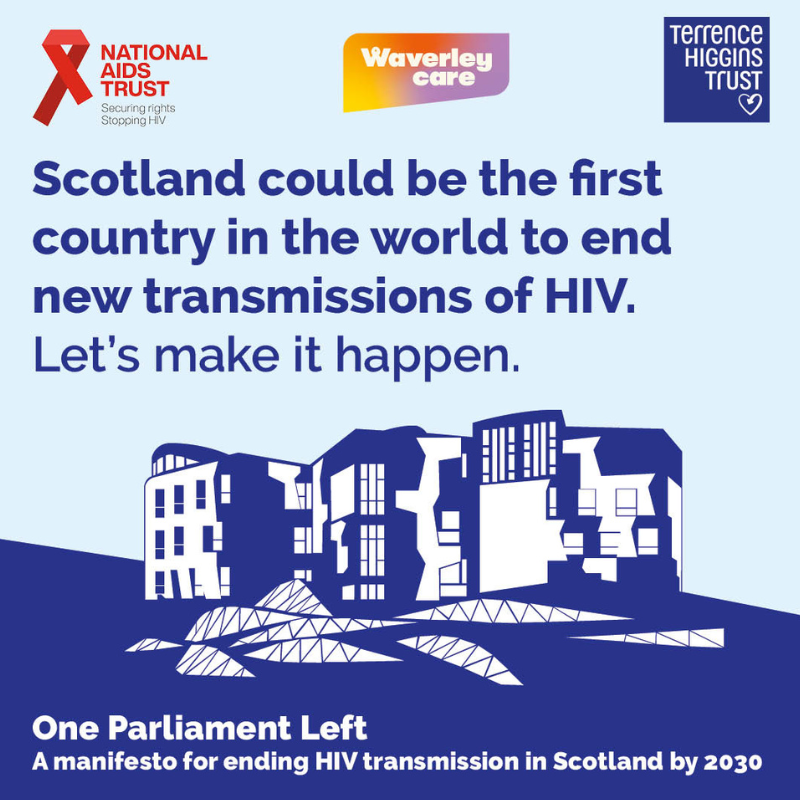
The Scottish Government committed in 2020 to ending new HIV cases by 2030, which would be the first time the onward transmission of any virus had been stopped without a vaccine or cure.
However, there are still an estimated 400 people in Scotland living with undiagnosed HIV, and up to 1,400 people who have been diagnosed but are no longer accessing life-saving care.
Terrence Higgins Trust, Waverley Care and National AIDS Trust have published a manifesto for ending new HIV transmissions in Scotland and are urging all political parties to commit to action ahead of the May election.
Medical advances mean that a person living with HIV and on treatment can live a long and healthy life and cannot pass HIV on to others. This progress – combined with the availability of the HIV prevention drug PrEP and rapid HIV testing – means Scotland has all the tools needed to reach its 2030 goal.
The charities are calling on the next Scottish Government to make sure these tools reach everyone who needs them – including through a national online HIV prevention service, providing at-home test kits and access to PrEP, a National HIV Testing Week and a programme to re-engage those who have been diagnosed but are not accessing HIV care.
Richard Angell OBE, Chief Executive of Terrence Higgins Trust said: 'The next intake of MSPs could be the generation that ends the HIV epidemic in Scotland. Scotland has an incredible history of leading the world in medical innovations – to be the first country in the world to this epidemic, and to do so without a vaccine or a cure, could be the incredible next chapter in that story. Swift action by the next government will be needed to make it a reality.'
Grant Sugden, Chief Executive at Waverley Care, said: 'Scotland has made significant progress towards ending new HIV transmissions. But to stay on course, we must go further and faster. Where improvements are shown to be effective, they must be rolled out and properly funded across the country. We must also take further action to ensure that everyone living with HIV in Scotland today can live well. The third sector has a vital role to play and must be recognised and funded as a key delivery partner. The next Scottish Government has the opportunity to turn this vision into reality - but it must act with urgency.'
Daniel Fluskey, Director of Policy at National AIDS Trust, said: 'We have all the tools to make the goal of ending new HIV transmissions in Scotland a reality. The effectiveness of treatment so that people living with HIV cannot pass the virus on, and the continual advancements in HIV prevention mean that in the next few years Scotland could be the first country to achieve the 2030 goal. This would be an amazing achievement, but it requires the next Scottish Government to make this a priority – the medicine and treatment alone isn’t enough, we need action to support people to live well with HIV and to end HIV-related stigma.'

Correction: of the 2,472 people prescribed PrEP for the first time in 2024, 88 were women (<4), rather than >4% as referenced in the manifesto document on page 6.