

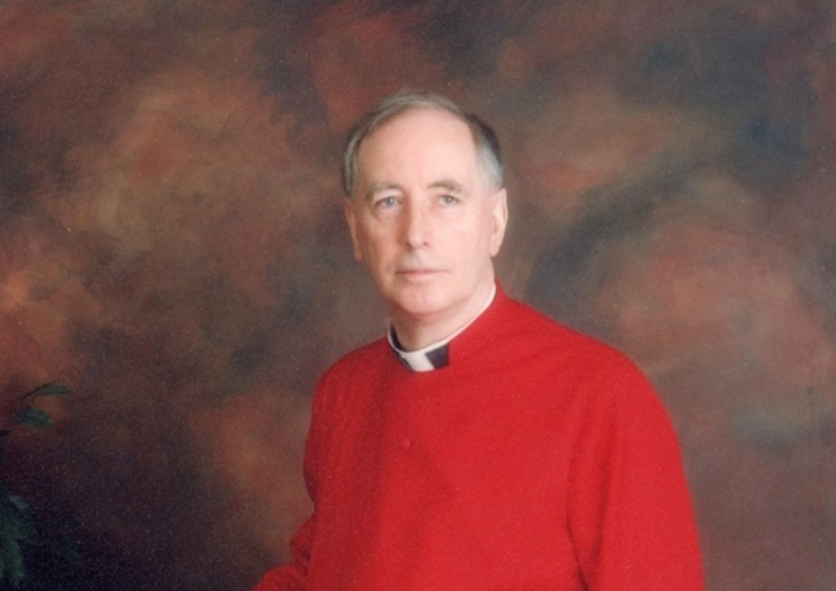
We mourn his death, aged 89, and our thoughts are with his long-term civil partner Robert Wilson, with whom he had been together for 57 years, and his friends.
Malcolm’s moral logic was always disarmingly simple. As he put it himself: “If clergy can bless battleships and budgerigars, we could bless two people in love…” That same clarity of purpose guided everything he did during the AIDS crisis, a period when the Church had a choice between retreat and solidarity, and Malcolm, almost alone among senior Anglican figures in London, chose solidarity without hesitation.
Standing With Us When It Mattered Most
When HIV began devastating gay communities in Britain in the early 1980s, the response from many religious institutions was silence, condemnation, or worse. Malcolm took a different path. As rector of St Botolph’s, Aldgate, a church he had made into a sanctuary for the Lesbian and Gay Christian Movement, he ensured it became the first church in the country to appoint a full-time minister to care for those affected by HIV, and opened a dedicated hostel for this purpose.
He had prepared himself carefully.
Recognising early on how little anyone knew, he travelled to the United States at the start of the 1980s to learn from American clergy who were already conducting funerals and caring for the dying. “I didn’t know much about HIV and AIDS so I went over there for about a week,” he recalled in a 2017 interview at the Athenaeum Club. “I met a lot of clergy who were taking funerals and looking after young people.” When he returned to London he founded the Ministers’ Group, an ecumenical network of clergy responding to AIDS, and brought figures including Bishop William Swing of California to speak to clergy about the unfolding epidemic.
Over the following years he conducted around 50 funerals for young men who had died of AIDS-related illness. Many had telephoned him in advance. “They knew they were very ill, they knew they wouldn’t last very long,” he said. “They would ring me up and say, ‘when I die will you take the service?’ And so of course I would go and see them, get to know them.” He recalled those men with grief and with love. “It broke my heart, because I got to know most of them. So many of the young men were very lovely and friendly and warm.”
He also went to the bishops of London and Southwark to insist that the Church address the reality that clergy themselves were living with HIV, and to put in place dignified arrangements for their pastoral care, without requiring disclosure to their congregations.
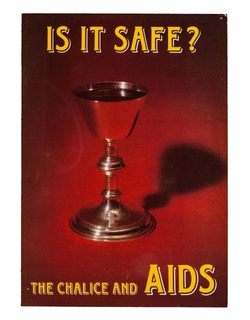
The Interfaith Group and Is It Safe?
Malcolm was a central figure in Terrence Higgins Trust’s Interfaith Group, the pioneering committee that brought together people of faith to respond to AIDS with information rather than fear. In 1986, the group produced one of the most remarkable documents of the epidemic: Is It Safe? The Chalice and AIDS — a pamphlet addressed directly to Christian congregations worried about receiving communion from a shared cup alongside people living with HIV.
The debate about the chalice was live and anxious. Malcolm had seen it up close. Parishioners came to him for guidance; his own partner had asked, in genuine distress, whether he should use separate plates when a friend with HIV came for supper. “He said: ‘What do I do? Do I treat him separately? Do I break the plates after he’s been?’” Malcolm recalled. “Most people didn’t know what the virus was and how it infected someone.” This drove him on.
The pamphlet the Interfaith Group produced was straightforward, compassionate, and courageous. It stated plainly that the virus could not be spread through surface contact, that the chalice was a poor medium for transmitting infection, and that the alcohol in communion wine acted as an antiseptic. But it went further than mere virology. It confronted, directly, the idea that for a Christian to avoid communion out of fear of AIDS would cause grievous harm: it would make those already suffering feel excluded and unwanted by the Christian family of which they were a part. And it addressed head-on the cruellest slander of the epidemic, that AIDS was somehow God’s punishment: “God does not punish through suffering and disease.”
The pamphlet closed with a prayer and a direct appeal for support for Terrence Higgins Trust. That a document this humane, this scientifically grounded, and this theologically confident could be produced at the height of the epidemic’s stigma speaks volumes about Malcolm’s leadership and the ecumenical community he helped to build around THT.
A Pioneer Shaped by East London
Malcolm spent almost twenty years at St Botolph’s, Aldgate, from 1974, before serving as Master of the Royal Foundation of St Katharine in Wapping until his retirement in 1997. Throughout this time the East End was his parish in the broadest sense, its homeless, its addicted, its gay and lesbian residents, and those living with HIV all found in him a priest who, as he said of his approach to those others turned away, believed “you have to accept people as they are.”
He was not above fear himself. He recalled standing in front of a mirror during a holiday in Venice and thinking he would probably be dead within a year. He never went for an HIV test. “Too scared,” he said simply. “Most people were too frightened. It was a death sentence originally.” That admission, honest, unguarded, made by a man who had spent years comforting others through their own terror, only deepens what he achieved. He ministered to the dying not from a position of invulnerability, but from inside the same fear, choosing over and over again to show up anyway.
A Legacy That Lives On in Terrence Higgins Trust’s Work
Malcolm Johnson did not perform compassion. He organised it, preached it, funded it, and, when necessary, defended it against a Church establishment that routinely wanted him to be quieter. He refused. The result was a generation of LGBT+ people and people affected by HIV who found, perhaps to their surprise, that a church could be a source of love rather than judgment.
At Terrence Higgins Trust, we remember him with deep gratitude. His involvement in our Interfaith Group helped shape the public health response to AIDS in faith settings at a moment when that work was genuinely life-saving. His refusal to stand at a safe distance, from those who were dying, from those who were grieving, from those whom the rest of the Church preferred not to see, is an example that continues to guide us.
He was, in the best sense, a Pink Bishop. We shall not see his like again.
The Revd Dr Malcolm Johnson’s funeral takes place on 11 May 2026 at St Martin-in-the-Fields, Trafalgar Square, London.