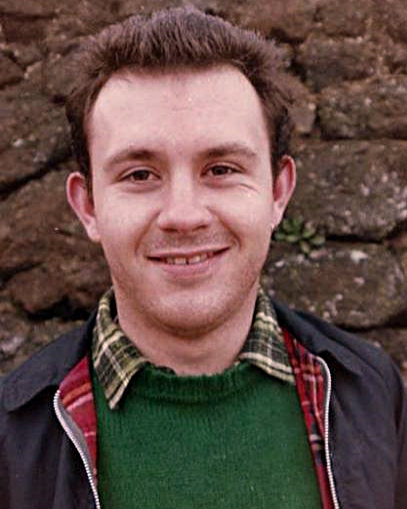
I am very pleased that the name of my friend Mark Ashton is on the Red Ribbon Fund memorial plaque. I would like to tell you a bit about him. Mark was enthusiastic about Terrence Higgins Trust from the start – long before he was diagnosed with HIV. I remember him taking me to Terrence Higgins Trust’s first headquarters at Mount Pleasant, probably in 1986, before the charity moved to the other end of Gray’s Inn Road.
He will have a small footnote in the history books of the 20th century as he, together with Mike Jackson, formed a remarkable organisation during the miners’ strike of 1984-1985 called Lesbians and Gays Support the Miners. This not only broke down homophobic prejudice and built bonds between the gay community and the mining communities in south Wales, but also raised an amazing £22,000 to help support the miners’ families.
Mark was a very special person with many facets – he was a student, writer, public speaker, organiser, gay activist, Communist, good friend and a very human being. When he was around 20, he spent three months in Bangladesh and the dreadful poverty he saw there had a profound effect on him. When he came back to London, he joined the Communist Party.
He answered the phones at Gay Switchboard. He supported the Campaign for Nuclear Disarmament. He threw himself body and soul into political work.
He was diagnosed with HIV on 30 January 1987. I went to Guy’s Hospital that evening where Mark was sitting up in bed, holding court and generally camping it up. He was suffering from PCP – a form of pneumonia which was a common cause of death in people with AIDS-related illnesses before antiretroviral treatment was available. By the following afternoon, the PCP had made him too ill for visitors. One of those turned away was the General Secretary of the Communist Party.
Every day after work I went to the hospital with Mark’s former lover Johnny. On the fourth day I took him an apple strudel, which I knew he loved, but the Septrin – a strong antibiotic used to treat PCP – clearly was not working and I doubt whether Mark was able to eat it. Every morning I phoned the hospital and on 11 February the nurse told me he had died at 5am – just 12 days after his diagnosis. He was only 26.
I’m told I didn’t smile for three months after his death. His funeral in the chapel at Lambeth Crematorium was packed out with many people unable to get in. There were 300 people at his memorial. He changed my life. It was because of Mark’s death that I went to work at London Lighthouse to try to give others the love and care I had been unable to give Mark. He was deeply loved and is terribly missed by me and hundreds of others.
Mark’s friends set-up the Mark Ashton Memorial Fund in his memory, with donations going to Terrence Higgins Trust. It has raised over £46,000.
Donate now to the Mark Ashton Memorial Fund to continue Mark’s legacy.